Why Does Nepal Have a Non-Rectangular Flag?
Picture every national flag you have ever seen. The stars and stripes of the USA. The red circle of Japan. The tricolor of India. Different colors, different symbols — but they all share one thing. They are rectangles.
Every flag in the world, except one.
High in the Himalayas, the small country of Nepal flies a flag that looks like two triangles stacked on top of each other. It is the only national flag on Earth that is not a rectangle. And the reason behind it is a wonderful mix of history, religion, mountain pride, and — believe it or not — mathematics.
Let's unfold this story, one triangle at a time.
Quick Facts About Nepal's Flag
FactDetailShapeTwo stacked triangles (called a "double pennon")ColorsCrimson red with a deep blue borderSymbolsWhite moon (top) and white sun (bottom)Officially adoptedDecember 16, 1962Design ageCenturies old — far older than 1962Unique claimThe world's only non-rectangular national flag
Did You Know? Nepal's flag is also one of the few flags that is taller than it is wide. Almost every other flag in the world is wider than it is tall.
What Does the Flag Actually Look Like?
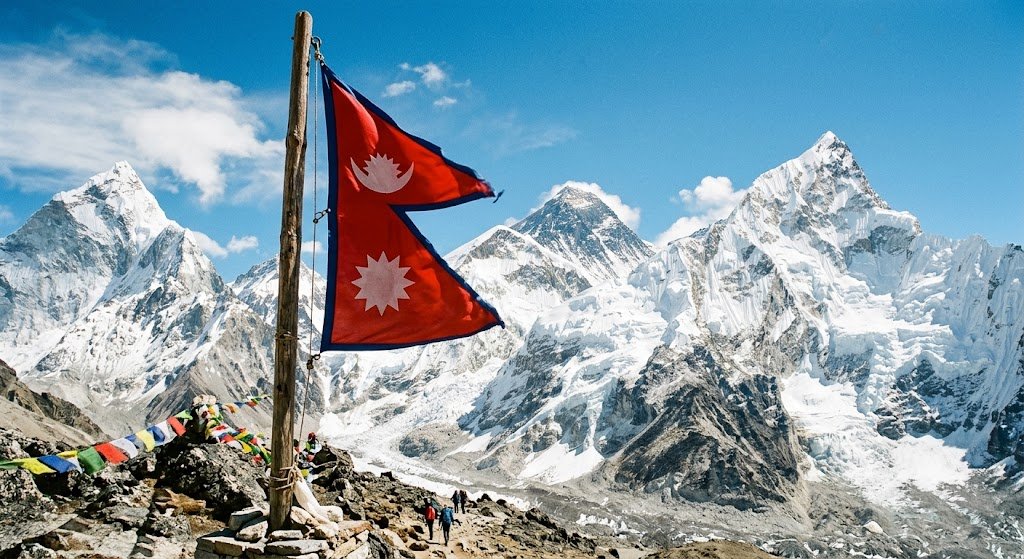
Imagine cutting a rectangle diagonally, twice, so you end up with two triangle-shaped pennants — the kind of small flags you might see waving at a castle in a storybook. Now stack one on top of the other. That is Nepal's flag.
The background is crimson red, a deep pinkish-red. A blue border runs all the way around the zigzag edge. Inside the top triangle sits a white moon with rays. Inside the bottom triangle shines a white sun with twelve points.
The first thing most travelers notice when they land in Kathmandu is how different this flag feels next to the rectangular flags of other countries at the airport. It almost looks like two flags decided to become best friends.
The Real Answer: Why Two Triangles?
Here is the short version: Nepal never gave up its old flag tradition, while the rest of the world did.
Flags Before Rectangles
Long ago, flags in South Asia were not rectangles at all. Hindu and Buddhist kingdoms flew triangular pennants for thousands of years. You can still see these triangle flags today fluttering above temples across Nepal and India. The rectangle flag, on the other hand, is largely a European tradition that spread across the globe through trade, empires, and colonization.
Nepal Was Never Colonized
This is the key. Nepal is one of the very few countries in Asia that was never ruled by a European power. While colonized nations often adopted European-style rectangular flags — sometimes keeping them even after independence — Nepal had no reason to change. Its rulers simply kept the triangular pennants their ancestors had always flown.
So Nepal's flag is not strange at all. In a way, it is the last survivor of the world's oldest flag style.
Two Flags Become One
One thing people often don't realize is that Nepal's flag was originally two separate pennants. For centuries, rulers of Nepal flew two triangular flags, one above the other. Over time, the two pennants were joined into a single flag. When Nepal wrote a new constitution in 1962, this joined design was made official, and the flag we know today was born.
Fun Fact: Before 1962, the sun and moon on the flag had human faces! The faces were removed to give the flag a cleaner, more modern look.
What Do the Colors Mean?
Every part of Nepal's flag tells a story.
Crimson red is the color of the rhododendron, Nepal's national flower, which paints entire mountainsides pink and red every spring. Crimson also stands for the bravery of the Nepali people — the same spirit found in the famous Gurkha soldiers.
Blue, forming the border, represents peace and harmony. So the flag carries a simple message: a brave nation, wrapped in peace.
The Sun and the Moon: A Wish to Last Forever
Why put a sun and a moon on a flag? The answer is beautiful.
The sun and moon express a hope that Nepal will exist for as long as the sun and moon remain in the sky. It is like a birthday wish, stitched into fabric, made by an entire country.
There is a second layer of meaning too, and it matches Nepal's geography perfectly:
- The moon represents the cool, calm air of the Himalayas in the north — home to Mount Everest.
- The sun represents the heat of the Terai, the warm lowland plains in the south.
One small flag, capturing an entire country's landscape from the world's highest peaks down to steamy jungle plains. Not bad for two triangles.
Quick Insight: The moon is also said to symbolize the calm nature of the Nepali people, while the sun stands for their fierce determination. Calm and fierce — just like the mountains themselves.
The Flag With Math Homework Built In
Here is where the story gets delightfully nerdy.
Most countries describe their flags in simple words: "three equal stripes" or "a star in the center." Nepal went much further. Its constitution contains a full step-by-step geometric recipe for drawing the flag — over twenty steps of lines, arcs, and measurements, almost like instructions from a geometry textbook.
If you follow every step exactly, something surprising happens. The flag's width-to-height ratio comes out as an irrational number — a number whose decimals go on forever without repeating, roughly 1 to 1.219. Mathematicians around the world have studied it just for fun.
This becomes easier to understand when you think of it like a secret recipe. Anyone, anywhere, can bake a perfect Nepali flag — as long as they follow the recipe exactly.
Travel Tip: Visiting Kathmandu? Look up at government buildings around Durbar Square and you'll spot the flag everywhere. Souvenir shops in Thamel sell small versions that make a genuinely unique gift — no other country's flag looks like it.
How Does It Compare With Neighboring Flags?
Nepal sits sandwiched between two giants, and the contrast is striking.
CountryFlag ShapeMain FeatureNepalDouble triangleSun and moon on crimsonIndiaRectangleSaffron, white, green with a wheelChinaRectangleRed with five gold stars
If you compare this with the region's history, the pattern makes sense. India's flag follows the rectangular standard that became global during the colonial era. Nepal, never colonized, kept the ancient South Asian pennant shape. Its flag is a piece of living history that its neighbors' flags no longer carry.
Interesting Facts About Nepal's Flag
- It is the only non-rectangular national flag among all the countries in the world.
- The design is centuries old, but it became official on December 16, 1962.
- The two triangles are often said to represent the Himalayas, and also the country's two main religions, Hinduism and Buddhism.
- The constitution's drawing instructions are so precise that math teachers use the flag in geometry lessons.
- Within the United States, the state of Ohio also has a non-rectangular flag — but among national flags, Nepal stands completely alone.
- Because of its shape, displaying the flag at international events sometimes requires special poles and arrangements so it hangs correctly.
Pros and Cons of a Non-Rectangular Flag
Pros:
- Instantly recognizable — nobody ever confuses Nepal's flag with another country's.
- Preserves a flag tradition thousands of years old.
- A powerful symbol of independence and identity.
Cons:
- Harder to manufacture and display than standard flags.
- It can look odd on websites, emojis, and scoreboards designed for rectangles (designers often place it on a white rectangle background).
- Drawing it correctly requires real effort — or a geometry lesson.
Frequently Asked Questions
Why is Nepal's flag not rectangular?
Nepal's flag keeps the ancient triangular pennant style used by Hindu and Buddhist kingdoms for centuries. Because Nepal was never colonized by a European power, it never switched to the European rectangular flag style. When the modern flag became official in 1962, Nepal proudly kept its traditional double-triangle shape.
Is Nepal's flag the only non-rectangular flag in the world?
Among national flags, yes. Nepal's is the only one that is not a rectangle or square. A few regional flags break the rule too — the American state of Ohio uses a swallowtail shape — but no other independent country has a non-rectangular national flag.
What do the two triangles on Nepal's flag represent?
The two triangles are commonly said to represent the peaks of the Himalayas, the mountains that define Nepal. They are also often described as symbols of the country's two major religions, Hinduism and Buddhism. Historically, they come from two separate royal pennants that were joined into one flag.
What do the sun and moon on Nepal's flag mean?
They express the hope that Nepal will last as long as the sun and moon exist. The moon also represents the cool Himalayan north and the calm nature of the people, while the sun represents the hot southern plains and the nation's fierce resolve.
When was Nepal's flag officially adopted?
The current flag was officially adopted on December 16, 1962, along with a new constitution. However, the design itself is centuries older. The 1962 version mainly modernized the flag — most famously by removing the human faces that used to appear on the sun and moon.
What does the crimson red color stand for?
Crimson is the color of the rhododendron, Nepal's national flower, which blankets the hillsides every spring. It also represents the bravery and courage of the Nepali people, a quality the world associates with Nepal's legendary Gurkha soldiers.
What does the blue border mean?
The blue border surrounding the flag stands for peace and harmony. Combined with the crimson center, the flag delivers a simple, elegant message: a courageous nation surrounded and protected by peace.
Is it true that Nepal's flag involves complicated math?
Yes. Nepal's constitution includes a detailed geometric procedure — more than twenty steps — explaining exactly how to draw the flag. Following it precisely produces a width-to-height ratio that is an irrational number, roughly 1 to 1.219. It may be the most mathematical flag on Earth.
Was Nepal ever colonized?
No. Nepal is one of the few Asian countries that was never colonized by a European power. This independence is a major reason its flag never changed to the rectangular style that spread worldwide during the colonial era.
Why did the sun and moon lose their faces?
Until 1962, both the sun and moon on the flag were drawn with human faces, following older artistic traditions. When the flag was standardized under the new constitution, the faces were removed to create a simpler, more modern national symbol.
How is Nepal's flag displayed at international events?
Because it is not a rectangle, Nepal's flag sometimes needs special handling. At events like the Olympics, it is flown in its true shape, standing out instantly among rows of rectangles. On screens and printed charts, it usually appears against a plain background so its outline stays clear.
Is Nepal's flag taller than it is wide?
Yes — and that makes it doubly unusual. Almost every national flag is wider than it is tall. Nepal's flag, when drawn exactly by the constitutional method, ends up slightly taller than wide, with that famous irrational ratio of about 1.219 in height for every 1 unit of width.
Conclusion
Nepal's flag is far more than an unusual shape. It is a survivor — the last of the world's ancient pennant flags still flying as a national symbol. Its triangles echo the Himalayas, its colors bloom like rhododendrons, its sun and moon whisper a wish for the country to last forever, and its geometry hides a math puzzle in plain sight.
So the next time someone asks why Nepal's flag isn't a rectangle, you can smile and answer: it's not that Nepal's flag is strange. It's that Nepal is the only country that never stopped being itself.